
Signage Fabrication in Dubai: The Complete Guide to Outdoor Signage in the UAE

Walk through any commercial district in Dubai, Abu Dhabi, or Sharjah and one thing is immediately clear — signage is everywhere. From towering hoardings along Sheikh Zayed Road to precision-crafted 3D letters above boutique storefronts, the UAE's visual landscape is defined by bold, well-built signs. But behind every great sign is a fabrication process that most people never see. Understanding how signage is made — and what separates a sign that lasts from one that doesn't — can make a significant difference when you're planning any kind of commercial or brand installation.
What Is Signage Fabrication?
Signage fabrication is the process of designing, producing, and assembling physical signs for commercial, corporate, or public use. It covers everything from the structural framework and material selection to the printing, finishing, and installation of the final

product.
Unlike simple print-and-mount solutions, fabricated signage involves engineering decisions. The type of metal used, the thickness of acrylic panels, the waterproofing of LED components, the load-bearing capacity of mounting brackets — all of these factors determine how a sign performs in the real world, especially in a climate as demanding as the UAE's.
Why the UAE Climate Changes Everything for Outdoor Signage
The UAE presents some of the harshest environmental conditions any sign will ever face. Summer temperatures regularly exceed 45°C, UV radiation is intense throughout the year, and coastal cities like Dubai and Abu Dhabi add humidity and salt air into the mix. Sandstorms — common across the region — introduce abrasion that gradually degrades surface finishes and seals.
For outdoor signage specifically, these conditions mean that material choices and fabrication standards are not just a quality consideration — they're a durability requirement. A sign fabricated without accounting for Gulf climate realities may look fine at installation but begin fading, warping, or corroding within 12 to 18 months.
The best fabricated signs in the UAE are built with this in mind from day one — with materials and finishes chosen specifically for long-term performance under extreme conditions.
The Signage Fabrication Process Explained
While every fabrication company operates slightly differently, the core process typically follows these stages:
1. Brief and Consultation The process begins with understanding the project requirements — the type of sign, the location, the viewing distance, the brand guidelines, and the installation environment. Indoor and outdoor signs have very different engineering needs.
2. Design and Technical Drawing Once the brief is clear, a design is developed — not just visually, but technically. Fabrication-ready drawings include dimensions, material specifications, structural details, and electrical plans for illuminated signs.
3. Material Procurement Quality fabricators source materials matched to the project requirements. For outdoor use in the UAE, this typically means aluminium composite panels, marine-grade metals, UV-stable acrylic, and weatherproofed LED components.
4. Cutting and Forming Modern fabrication uses CNC routing, laser cutting, and press-forming machines to cut and shape materials with precision. This stage determines the structural accuracy of the final sign.
5. Assembly and Finishing Components are assembled, welded or bonded as required, and finished with powder coating, vinyl wrapping, or paint systems rated for outdoor exposure.
6. Quality Inspection A thorough inspection checks structural integrity, electrical safety (for illuminated signs), colour accuracy, and finish consistency before delivery.
7. Installation Professional installation ensures the sign is mounted safely, at the correct position and angle, with all fixings and weatherproofing seals properly applied.
Common Types of Fabricated Signs in the UAE
3D Letter Signs Channel letters and built-up lettering are among the most popular sign types across UAE retail and corporate environments. They can be front-lit, back-lit (halo effect), or non-illuminated, and are typically made from aluminium or stainless steel with acrylic faces.
LED Lightboxes A lightbox is a framed panel with a translucent face lit from behind by LED strips. They're widely used in retail, F&B, and transportation environments for their brightness and energy efficiency.
Hoarding and Billboard Structures Large-format structures used across construction sites, highways, and commercial developments. In the UAE, these must be engineered to handle wind loads and sandstorm conditions.
Wayfinding and Directional Signs Systematic signage that guides people through spaces — used in malls, hospitals, airports, and office buildings. Good wayfinding design is as much about information architecture as it is about fabrication.
Vehicle Wraps and Fleet Branding Vinyl-based branding applied to vehicles, turning company fleets into moving advertising across UAE roads.
Exhibition and Event Structures Modular or custom-built display systems for trade shows, brand activations, and events — designed for assembly, disassembly, and reuse.
Materials Commonly Used in UAE Signage Fabrication
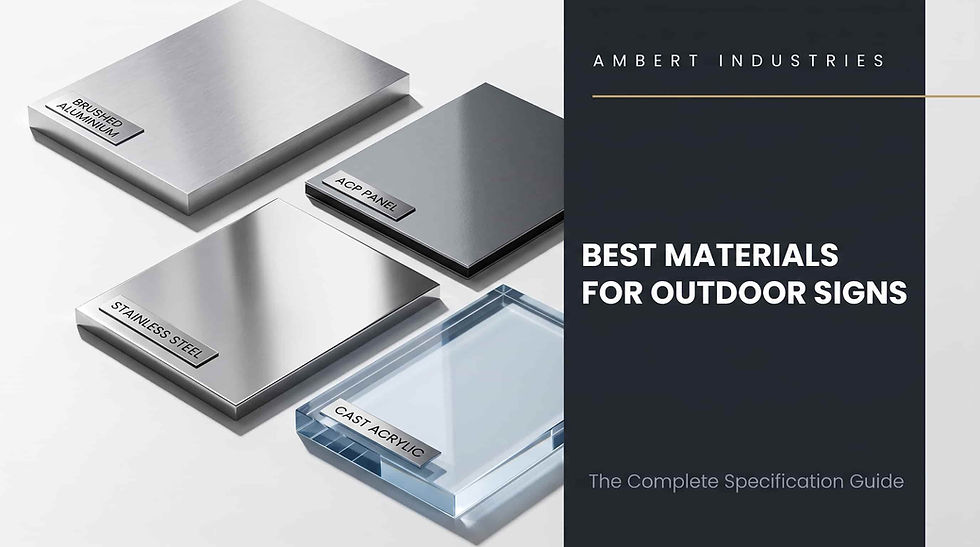
Aluminium Composite Panel (ACP) — Lightweight, flat, and easy to cut and print on. Widely used for flat sign faces and cladding.
Stainless Steel — Durable, corrosion-resistant, and premium in appearance. Common in 3D letters and architectural signage.
Acrylic (Perspex) — Available in dozens of colours and finishes. UV-stable grades are essential for outdoor applications.
Mild Steel — Used for structural frameworks and mounting systems, typically powder-coated for weather protection.
PVC and Foam Board — Cost-effective for short-term or indoor applications, but not suited to outdoor UAE conditions long-term.
UV-Resistant Vinyl — Used for printed graphics, vehicle wraps, and window displays. Outdoor-grade vinyl should carry a minimum 5–7 year UV rating for the Gulf climate.
What to Look for When Choosing a Signage Fabricator in Dubai
Whether you're a business owner, a marketing manager, or a project consultant, choosing the right fabrication partner matters. Here's what to consider:
In-house production — Fabricators with their own production facility have tighter quality control than those who outsource manufacturing.
Material transparency — A good fabricator will specify exactly which materials they're using and why, not just quote a price.
UAE climate experience — Ask for examples of signs they've installed outdoors in the UAE and how they've held up over time.
Installation capability — Fabrication and installation should ideally be handled by the same team to ensure accountability.
After-sales support — Illuminated signs require maintenance. Confirm whether the fabricator offers servicing agreements.



Comments