
The Best Materials for Outdoor Signs — A Plain Guide

Picking the wrong material for an outdoor sign is one of the most common mistakes businesses make.
Not because the sign looks bad immediately. Most signs look fine when they're new. The problem appears at month eight, or year two — when colours start washing out, edges begin lifting, or the surface develops that chalky film that no amount of cleaning fixes.
Climate plays a huge role in this. High UV index, extreme surface temperatures, coastal humidity, and constant sand and dust create conditions that most standard sign materials simply aren't built for. What works in a cooler climate can fail fast in a harsh outdoor environment.
Here's a plain breakdown of the main materials used for outdoor signs, what each one does well, and where each one falls short.
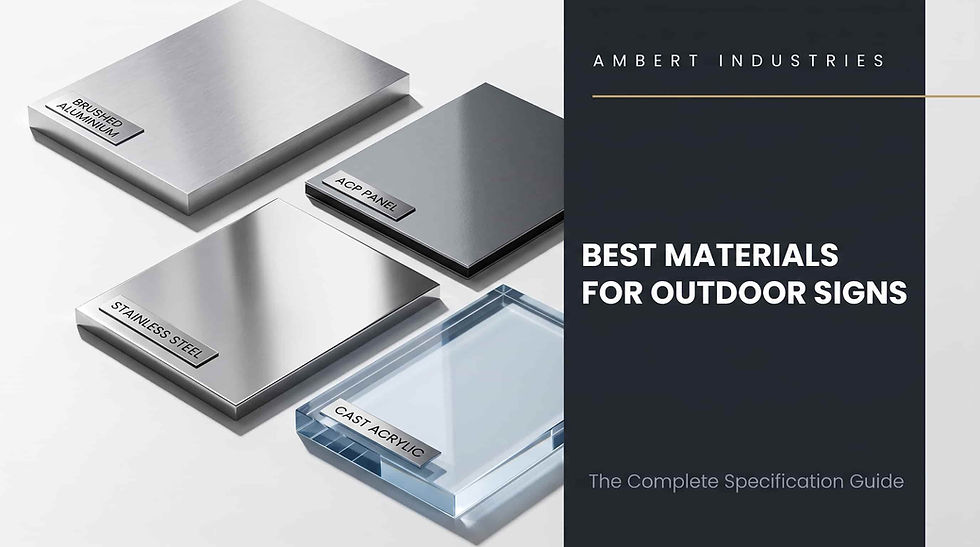
Aluminium Composite Panel — The Most Widely Used Option
Aluminium composite panel — commonly called ACP — is two thin aluminium sheets bonded around a polyethylene core. It's lightweight, flat, easy to cut into shapes, and takes vinyl or digital print well.
The specification matters more than the material name. Exterior-grade ACP uses a PVDF or SMP coating on the aluminium faces that resists colour fade and surface degradation in high UV conditions. Standard ACP without this coating fades visibly within 18 months in direct sun.
The right grade holds colour for five to seven years without looking washed out. It's also rust-proof — an important factor near coastal areas.
Best for: Shopfront fascia signs, building cladding, flat panel signs, hoarding graphics.
Limitation: Not suitable for complex curved forms. The polyethylene core can soften slightly under extreme heat on very large unsupported panels if the mounting structure isn't correctly designed.
Solid Aluminium — Durable and Weather-Resistant
Solid aluminium is heavier and more expensive than ACP but genuinely tough. It doesn't warp in heat, doesn't rust, and the surface takes powder coating or anodising well. Both finishes hold up well in harsh outdoor conditions — powder coating in particular provides a hard, UV-stable surface that doesn't need repainting.
It's commonly used for cut-out lettering, fabricated sign trays, and structural frameworks behind larger sign installations. For anything that needs to hold dimensional shape across years of thermal expansion and contraction, solid aluminium outperforms most alternatives at a similar price point.
Best for: Built-up letters, sign trays, premium shopfront fabrication, structural sign frameworks.
Limitation: Higher fabrication cost and heavier installation requirements. Not the right choice for large flat-panel applications where ACP achieves the same result at lower weight and cost.
Stainless Steel — The Prestige Choice
Stainless steel doesn't rust, doesn't fade, and doesn't warp. Brushed stainless gives a
high-end finish that works well for hotel entrances, luxury retail, and corporate building signage. Mirror-polished stainless creates a reflective surface that draws attention in high-footfall locations.
It's the most expensive material on this list to fabricate and the heaviest to install. The fixing and anchoring requirements are more demanding — especially for large-format installations on glass or aluminium facade systems.
For the right project, though, nothing else gives the same result. A stainless steel sign on a prestige property can still look sharp ten years later with minimal maintenance.
Best for: Premium sign installations, hotel and hospitality entrances, corporate headquarters, luxury retail facades.
Limitation: Cost and weight. Not suitable for high-volume commercial applications where budget is the primary constraint.
Cast Acrylic — For Illuminated Signs
Acrylic is the standard face material for illuminated signs — channel letters, lightboxes, and backlit panels. Light travels through it evenly, it holds printed colour well, and it can be formed into dimensional shapes.
The critical specification for outdoor use in high-UV environments is cast acrylic, not extruded. Extruded acrylic yellows and becomes brittle in sustained sun exposure. Cast acrylic with a UV stabiliser resists this significantly better and holds its clarity for longer.
For any illuminated sign that will be installed outdoors — LED-lit channel letters, backlit fascia panels, illuminated lightboxes — cast acrylic is the face material of choice.
Best for: Illuminated channel letters, lightboxes, backlit sign panels.
Limitation: Not suitable as a structural material or for large unlit flat panels outdoors. Requires correct grade specification for harsh UV environments.
The Part Nobody Talks About — The Fixing System
The material is one decision. How it's fixed to the building is the other half.
Signs made from perfectly good materials can fail within two years — not because the material was wrong, but because the mounting system wasn't engineered for the application. Wind load is real. Thermal expansion causes material movement that poorly designed fixing systems can't accommodate. Coastal environments accelerate corrosion in exposed fixings.
A properly specified outdoor sign is designed as a complete system — face material, backing frame, fixing method, and wall anchoring — not just a panel bolted to a wall. If your supplier is only talking about the face material and not the full installation engineering, that's a gap worth asking about before you sign off.
Quick Material Selection Guide
Application | Recommended Material |
Flat fascia panel | Exterior-grade ACP |
Built-up letters | Solid aluminium |
Illuminated channel letters | Cast acrylic + aluminium tray |
Premium entrance sign | Brushed stainless steel |
Temporary hoarding | UV-laminated flex on frame |
One Team Behind Every Project We Take On
Planning an outdoor sign and want to get the material specification right from the start? Ambert designs, fabricates, and installs across Dubai — handling everything from material selection to engineered installation.
Explore what we do: signage board | outdoor signage | large format printing | Exhibition Stand
Frequently Asking Questions
What is the most durable material for outdoor signs?
For most commercial applications, exterior-grade ACP on an aluminium frame is the most durable and cost-effective combination. For prestige or long-life installations, stainless steel offers the longest service life with the least maintenance required.
How long do outdoor signs last?
A correctly specified and installed outdoor sign lasts five to seven years before requiring significant maintenance or replacement. Signs built with substandard materials or incorrect UV ratings can show visible degradation within 18 months.
Is acrylic suitable for outdoor use?
Cast acrylic with UV stabiliser is suitable for illuminated outdoor sign faces — channel letters and lightboxes. Standard extruded acrylic is not recommended for sustained outdoor exposure as it yellows and becomes brittle over time.
Does the fixing method affect how long a sign lasts?
Yes — significantly. Incorrect fixing systems allow movement from thermal expansion and wind load that causes signs to lift, crack, or detach over time. The fixing method should be engineered specifically for the wall substrate and the sign's dimensions and weight.
What material is used inside an illuminated sign?
Illuminated signs typically use cast acrylic faces with aluminium fabricated trays and LED modules inside. The aluminium tray provides the structural form and heat management, while the acrylic face diffuses light evenly across the sign surface.



Comments