
What Is the Difference Between Indoor and Outdoor Signage in Dubai?

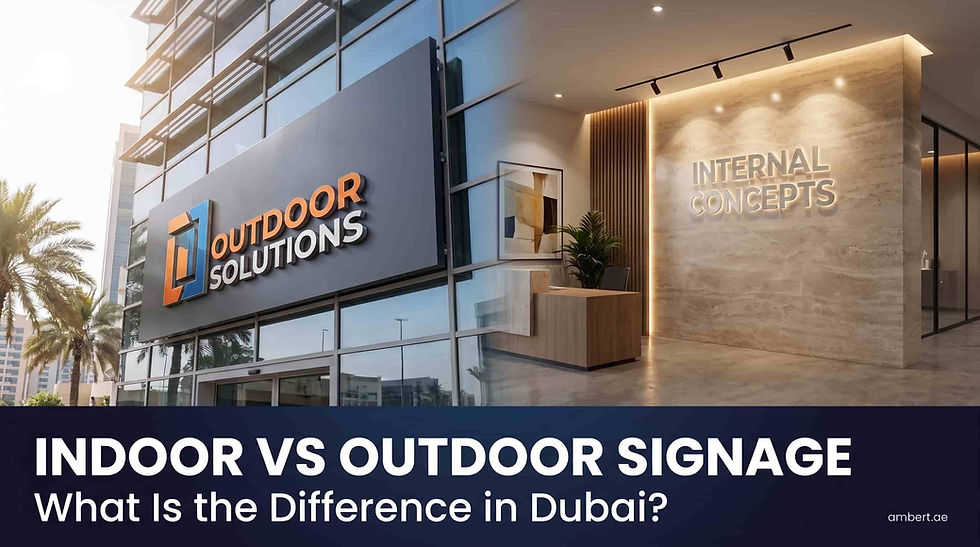
The difference is not just about where the sign goes. It goes deeper than that — into the materials, the fabrication process, the finish specification, and the service life expectation. A sign specified correctly for an indoor environment will fail prematurely outdoors. A sign over-specified for indoor use wastes budget on properties the environment never demands.
Getting the distinction right upfront saves money, avoids replacement costs, and produces a better visual result for the environment the sign actually lives in. Here is what Dubai businesses need to understand before approaching any signage company.
At Ambert, we are a signage company in Dubai — handling design, signage fabrication, and installation for indoor and outdoor signage across commercial, retail, hospitality, and corporate environments throughout the UAE.
What Is Outdoor Signage?
Outdoor signage covers every sign, board, and graphic system that faces external environmental conditions — UV radiation, rain, wind, temperature cycling, humidity, and in coastal areas, salt air. In Dubai's climate, these conditions are extreme by any international standard. The UV index regularly reaches 11 and above. Summer surface temperatures on metal sign faces exceed 70 degrees. Any material specified for outdoor signage in Dubai must handle these conditions without degrading, fading, or failing structurally.
Common outdoor signage types in Dubai include building fascia signs, pylon and totem signs, hoarding boards, entrance signs, directional wayfinding structures, LED illuminated sign cabinets, and external channel letter systems mounted to building facades.
The signage fabrication requirements for outdoor applications reflect these environmental demands. Materials must be UV-stable, weather-resistant, and dimensionally stable through temperature cycling. Fixings must be rated for wind load. Electrical components in illuminated outdoor signage must meet IP ratings for weather protection.
What Is Indoor Signage?
Indoor signage operates in a controlled environment — no direct UV exposure, no weather, and significantly less temperature variation than outdoor conditions. Consequently, indoor signage specifications can use materials, finishes, and lighting systems that would degrade or fail in an outdoor setting.
Common indoor signage types include reception wall signs, wayfinding and directory boards, corridor signage, room identification signs, retail display graphics, point-of-sale signage, and decorative environmental graphics. Furthermore, corporate interior signage — branded wall features, dimensional logo signs in reception areas, and office wayfinding systems — represents a significant portion of indoor signage fabrication work across Dubai's commercial sector.
Because indoor signage faces less physical stress than outdoor applications, the specification focus shifts from durability to visual quality. The finish standard, the material appearance, and the dimensional accuracy of indoor signage are more visible in the controlled lighting of an interior environment than they are in the complex outdoor visual context where outdoor signage operates.
Key Differences Between Indoor and Outdoor Signage
Materials
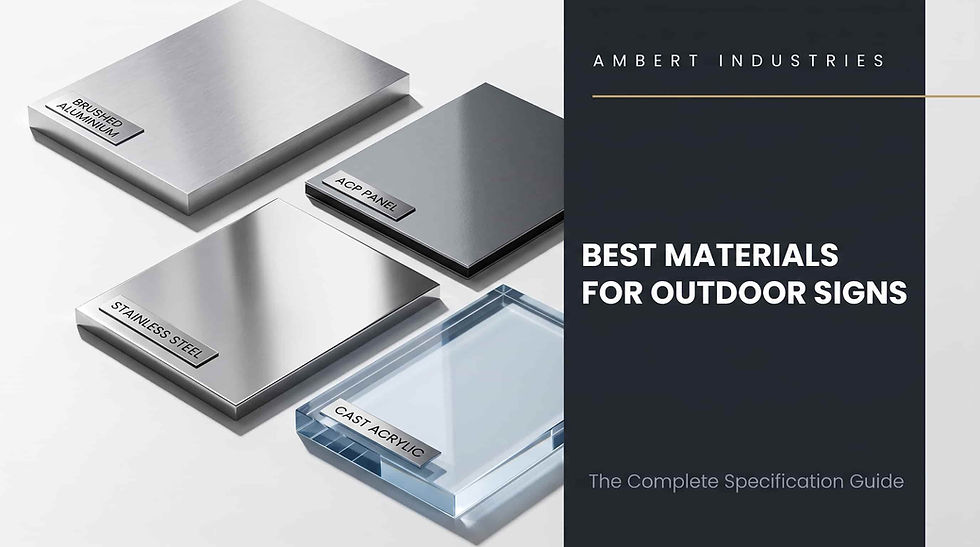
Outdoor signage in Dubai requires materials rated for sustained UV exposure, temperature cycling, and moisture. Aluminium composite panel is the standard substrate for flat outdoor sign faces — dimensionally stable, corrosion resistant, and available in PVDF coating grades rated for long-term outdoor UV exposure. Marine-grade stainless steel, powder-coated aluminium extrusions, and UV-stabilised acrylic are the other primary materials in Dubai's outdoor signage fabrication market.
Indoor signage uses a wider range of materials because the specification does not need to account for UV degradation, weather exposure, or structural wind loading. Standard acrylic, PVC foam board, MDF with surface treatment, brushed aluminium, and printed substrates all serve indoor signage applications that would be inappropriate or short-lived outdoors.
Finishes
Outdoor signage finishes must resist UV degradation, moisture, and physical contact from cleaning equipment and environmental debris. PVDF powder coating on aluminium, marine-grade anodising, and UV-resistant digital print with outdoor overlamination are the standard finish specifications for outdoor signage fabrication in Dubai's climate.
Indoor signage finishes can include a wider range — gloss and satin acrylic, vinyl applied graphics, brushed and polished metal finishes, lacquered MDF, and standard digital print. These finishes deliver excellent visual quality in controlled interior environments. However, they degrade rapidly under the UV and temperature conditions outdoor signage faces in Dubai.
Illumination
LED illumination appears in both indoor and outdoor signage — but the specifications differ significantly. Outdoor signage using LED illumination requires weatherproof LED modules rated to at least IP65, sealed cable entries, condensation management in the sign cabinet, and driver components rated for the operating temperatures Dubai's outdoor environment creates.
Indoor signage LED systems operate in controlled conditions and consequently use less robust — and less expensive — components. The same LED strip or module that serves an indoor reception sign would fail prematurely in an outdoor sign cabinet exposed to Dubai's summer heat and occasional rain.
Service Life
Quality outdoor signage in Dubai, correctly specified and installed, lasts 7 to 15 years before replacement or refurbishment is required. Incorrectly specified outdoor signage — materials chosen for indoor applications, standard inks without UV protection — may show visible degradation within 12 to 18 months.
Indoor signage, operating in controlled conditions without UV or weather exposure, lasts significantly longer relative to specification. A quality indoor reception sign or wayfinding system remains visually intact for 10 to 20 years with normal cleaning and maintenance.
The Signage Keywords to Know
Signage boards — flat panel sign faces, typically ACP or acrylic, used for both indoor and outdoor applications. The material grade and finish specification determines which environment each is suitable for.
Channel letters — three-dimensional letter forms fabricated from aluminium or stainless steel, typically face-illuminated or halo-illuminated with LED. Predominantly outdoor signage — building fascia signs and retail shopfront identification. Indoor channel letter installations appear in reception areas and branded feature walls.
Pylon signs — freestanding totem structures used as outdoor signage for building identification, wayfinding at site entrances, and roadside business identification across Dubai's commercial and industrial districts.
Wayfinding signage — directional and identification sign systems used indoors in large buildings — malls, hospitals, corporate campuses, and hotels — and outdoors in large site environments. Outdoor wayfinding signage fabrication uses weather-rated materials and fixings. Indoor wayfinding uses lighter specification materials appropriate for controlled environments.
LED signage — illuminated sign systems using LED modules for face illumination, halo illumination, or backlit graphic panels. Used across both indoor and outdoor applications with significantly different component specifications for each environment.
How to Choose Between Indoor and Outdoor Signage Specification
The choice is determined by the environment — not the preference. A sign positioned inside a building lobby with no direct weather exposure is an indoor sign regardless of how large it is or how prominent its position. A sign positioned on a building exterior or in any space directly exposed to sunlight, rain, or temperature extremes is an outdoor sign regardless of how sheltered its position appears.
Furthermore, semi-outdoor positions — covered car park entrances, building canopy areas, and retail colonnade environments — require careful assessment. These positions often receive indirect UV exposure and temperature cycling that damages standard indoor materials over time. Signage fabrication for semi-outdoor positions should err toward outdoor specification rather than indoor — the cost difference is modest and the service life difference is significant.
When in doubt — specify for the more demanding environment. A sign over-specified for its location costs slightly more upfront. A sign under-specified for its location costs replacement and reinstallation within 18 months.
Frequently Asked Questions
What is the difference between indoor and outdoor signage?
Indoor signage operates in controlled environments without UV, weather, or temperature extremes — allowing lighter materials and standard finishes. Outdoor signage faces UAE UV radiation, temperature cycling, and weather conditions that require UV-stable materials, weather-rated finishes, and weatherproof electrical components for illuminated signs.
What materials are used for outdoor signage in Dubai?
The standard materials for outdoor signage fabrication in Dubai are aluminium composite panel with PVDF powder coating, marine-grade stainless steel, powder-coated aluminium extrusions, and UV-stabilised acrylic. These materials handle Dubai's extreme UV radiation, high temperatures, and coastal humidity without degrading prematurely.
How long does outdoor signage last in Dubai?
Quality outdoor signage in Dubai, correctly specified with UV-resistant materials and finishes, lasts 7 to 15 years. Incorrectly specified outdoor signage — using materials designed for indoor applications — typically shows significant degradation within 12 to
18 months under Dubai's outdoor conditions.
Can indoor signage materials be used outdoors in Dubai?
No — indoor signage materials are not rated for the UV exposure, temperature cycling, and weather conditions that outdoor signage faces in Dubai. Standard acrylic, PVC foam board, and non-UV-rated digital print all degrade rapidly in Dubai's outdoor environment.



Comments