
Outdoor Signage Materials Built for Hot Climates Across Dubai and the UAE

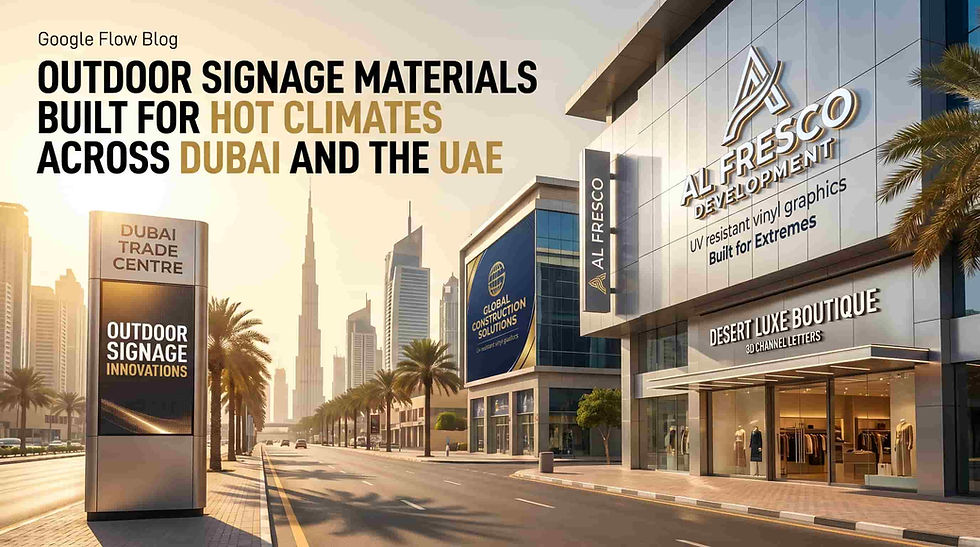
Dubai does not forgive poor material choices. The combination of intense UV radiation, temperatures that regularly exceed 45°C, salt-laden coastal air, and occasional sandstorms creates one of the most demanding environments for outdoor signage anywhere in the world.
A signage board that looks sharp on day one can warp, fade, delaminate, or structurally fail within months if the wrong materials were specified. For businesses across Dubai, Abu Dhabi, Sharjah, and Ras Al Khaimah, this is not a cosmetic problem — it is a brand problem and a safety problem.
This guide breaks down exactly which outdoor signage materials work in extreme heat, which ones fail, and what to look for when working with a signage company in Dubai on your next project.
Why Material Selection Matters More in the UAE Than Anywhere Else
Most global signage industry standards are built around temperate climates. Europe, North America, and large parts of Asia experience heat — but not sustained, day-after-day exposure to 40°C+ surface temperatures combined with direct desert sun.
In the UAE, a dark-coloured signage board mounted on a south-facing wall can reach surface temperatures of 70°C or higher during peak summer. At those temperatures:
Plastics soften, warp, and lose dimensional stability
Adhesive bonds between laminates and substrates fail
Printed inks oxidise and fade rapidly
Aluminium expands and contracts causing fastener stress
Electrical components in illuminated signs overheat
The signage industry in Dubai has adapted to these conditions over decades. Experienced fabricators know which materials survive and which ones create expensive callbacks six months after installation. Businesses that work with the right signage company in Dubai from the start avoid these problems entirely.
Outdoor Signage Materials That Perform in Extreme Heat
1. Aluminium Composite Panels (ACP)
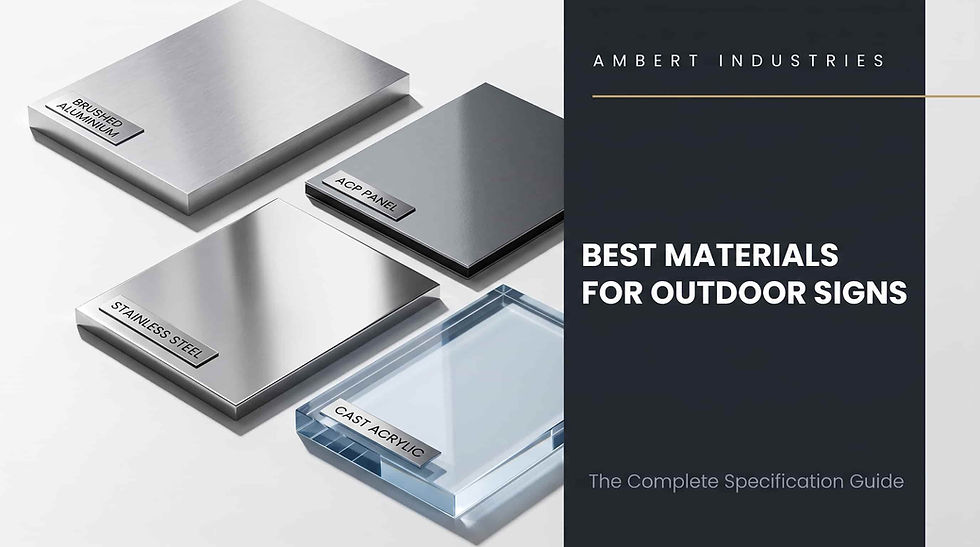
Aluminium composite panels are the backbone of outdoor signage fabrication in Dubai and across the UAE signage industry. The material consists of two thin aluminium sheets bonded to a polyethylene or fire-retardant mineral core — giving it rigidity, low weight, and strong resistance to heat and UV.
Why it works in Dubai:
The aluminium face reflects heat rather than absorbing it
Fire-retardant core variants (mandatory in many Dubai projects) add safety compliance
Dimensional stability holds across extreme temperature cycles
Surface coatings — PVDF in particular — resist UV fading for 10+ years outdoors
Lightweight enough for large format signage boards without excessive structural loading
Where it is used: Building fascia signs, large outdoor signage boards, hoarding panels, wayfinding systems, and retail frontage across Dubai and the wider UAE.
What to watch: Standard polyethylene core ACP is not fire-rated. For any project governed by Dubai Civil Defence regulations — which covers most commercial and high-rise applications — specify FR (fire retardant) or A2-rated core material. A competent signage company in Dubai will specify this automatically.
2. High-Density Polyethylene (HDPE)
HDPE is a dense, rigid plastic that handles heat far better than standard PVC or acrylic alternatives. It does not absorb water, resists UV degradation well when UV-stabilised grades are used, and maintains structural integrity across the temperature ranges common in UAE outdoor environments.
Why it works in Dubai:
UV-stabilised grades resist surface degradation and colour shift
Does not become brittle under sustained heat exposure the way standard plastics do
Chemical resistance makes it suitable for coastal environments in areas like Dubai Marina and Abu Dhabi Corniche
Easy to machine and fabricate for custom signage board shapes
Where it is used: Directional signs, outdoor wayfinding markers, parking signage, industrial site signage, and utility identification boards across the UAE.
3. Stainless Steel and Powder-Coated Mild Steel
Metal remains the most durable substrate available for outdoor signage fabrication in Dubai. For prestige applications — hotel entrances, corporate headquarters, luxury retail frontage — stainless steel delivers longevity that no other material matches.
Why it works in Dubai:
Grade 316 stainless steel resists corrosion even in coastal UAE locations with high salt air exposure
Powder coating on mild steel provides a durable, heat-resistant finish when correctly applied and maintained
Structural integrity is unaffected by heat at UAE ambient temperatures
Premium aesthetic suits the high-end commercial environment common across Dubai and Abu Dhabi
Signage fabrication considerations: Stainless steel signage fabrication requires skilled TIG welding, precision cutting, and proper surface finishing. Not all signage fabrication workshops in Dubai have this capability — it is worth confirming with your fabricator before specification.
Where it is used: 3D letter signs, monument signs, entrance identification, premium directional signage, and architectural signage elements across UAE commercial and hospitality projects.
4. Acrylic (PMMA) — With Caveats
Acrylic is widely used across the signage industry in Dubai for illuminated face signs, lightboxes, and decorative elements. It transmits light well, takes colour evenly, and machines cleanly for precise lettering and shapes.
However, standard acrylic has a critical limitation in UAE outdoor conditions: it
becomes soft and pliable at temperatures above 70°C — which, as noted, is reachable on sun-facing surfaces in Dubai summer.
When acrylic works outdoors in Dubai:
When used for illuminated sign faces where the LED backing keeps surface temperature lower
When mounted with adequate ventilation behind the face to prevent heat buildup
When UV-stabilised cast acrylic (not extruded) is specified — cast acrylic has significantly better UV and heat resistance
When used in shaded outdoor locations — covered walkways, undercanopy signage, sheltered frontages
When to avoid acrylic outdoors in Dubai:
Large flat panels in direct sun exposure without backing support
Applications where dimensional stability is critical and no shade is available
Thin gauge acrylic on large signage boards — heat causes visible bowing
An experienced signage company in Dubai will specify cast acrylic for outdoor applications and design ventilation into any illuminated sign housing to manage heat buildup.
5. Aluminium Extrusions and Profiles
Beyond flat panels, aluminium extrusions form the structural backbone of most professional outdoor signage fabrication across Dubai and the UAE. Channel letters, lightbox frames, signage board mounting systems, and post-and-panel wayfinding structures all rely on aluminium profiles.
Why it works in Dubai:
Corrosion resistant without additional coating in most UAE environments
Anodised finishes add UV resistance and surface hardness
Thermally stable across UAE temperature ranges — expansion is manageable and predictable
Lightweight relative to structural steel, reducing installation complexity and wind load on large outdoor signage boards
Aluminium extrusion work is a core competency of any serious signage fabrication operation in Dubai. The quality of the extrusion joinery and the accuracy of the cut angles determines how the finished sign looks and how long it holds up.
Materials to Avoid for Outdoor Signage in UAE Conditions
The signage industry in Dubai has learned — often expensively — which materials simply do not hold up in the local climate. Businesses specifying outdoor signage for Dubai and UAE projects should avoid:
Standard PVC foam board (Foamex/Forex) — softens and warps in direct sun; suitable only for short-term indoor use or temporary outdoor applications with a maximum lifespan of weeks in direct Dubai sun
Extruded acrylic in large format — dimensional instability under heat causes bowing and joint failure
Vinyl face applied to non-rigid substrates outdoors — adhesive fails rapidly under sustained heat; edges lift and peel within months
Untreated mild steel without powder coating — rusts aggressively in coastal UAE environments within weeks
Standard polyethylene core ACP in fire-regulated zones — regulatory non-compliance, not just a performance issue
What Good Outdoor Signage Fabrication Looks Like in Dubai
Material selection is only one part of the equation. How a signage board is fabricated and installed determines whether even the best materials perform correctly over time.
In Dubai's signage industry, the difference between a sign that lasts five years and one that needs replacement in twelve months is usually not the material alone — it is the quality of the fabrication:
Sealed edges on ACP and composite panels prevent moisture ingress at cut faces
Thermal expansion joints on large format signage boards prevent buckling through temperature cycles
Correct fastener specification — stainless steel fixings in coastal zones, not zinc-plated steel which corrodes rapidly
Ventilated housing on illuminated signs to manage internal heat from LED drivers and power supplies
UV-stable inks and laminates on any digitally printed outdoor signage board
Signage fabrication in Dubai that cuts corners on any of these details will produce a sign that looks acceptable on installation day and begins failing within the first summer.
Working With a Signage Company in Dubai on Material Specification
The right signage company in Dubai will not just quote what you ask for. They will question your specification if it is not right for the application, recommend materials based on your specific site conditions, and flag compliance requirements before fabrication begins.
Key questions to ask any signage company in Dubai before committing to a project:
What ACP core rating are you specifying and does it meet Dubai Civil Defence requirements for this application?
Are the inks and laminates UV-rated for UAE outdoor exposure?
What is the expected lifespan of this signage board in direct sun exposure?
Are fixings specified for coastal or inland conditions?
What is the warranty on materials and fabrication workmanship?
A signage company that answers these questions confidently and specifically — with technical backing — is operating at a professional level. One that gives vague reassurances is a risk.
Ambert Industries brings together full-scope signage fabrication capability in Dubai — from material specification and structural design through to fabrication, installation, and post-installation support — with deep experience across the UAE's unique climate and regulatory environment.



Comments